Architecting the Next Generation of SaaS: A Frontend Perspective
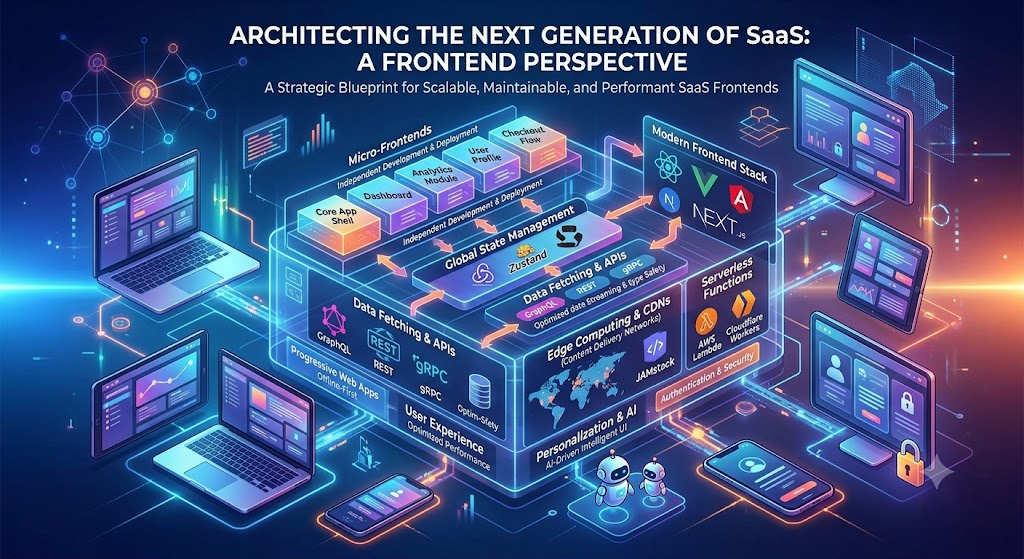
Scaling frontend applications for modern SaaS (Software as a Service) products is fundamentally about rethinking how architecture, design, and content flow together. As platforms evolve and user expectations peak, traditional development paradigms often create bottlenecks. Building a resilient, high-performance ecosystem requires a shift in how we structure our code, render our UI, and manage our state.
Here are the core engineering pillars for building a scalable, future-proof SaaS product:
1. The Monorepo Paradigm: Beyond Dependency Hell
Managing multiple repositories for different SaaS interfaces (e.g., a customer dashboard, an admin panel, and an internal engineering tool) quickly leads to fragmented codebases and "dependency hell."
Transitioning to a unified Monorepo architecture drastically improves the development workflow. This structural change allows engineering teams to share configuration files, linting rules, and utility functions universally. More importantly, it guarantees atomic commits—meaning a breaking change in a core utility is caught in the CI/CD pipeline across all applications simultaneously, rather than failing silently in production.
2. Next.js 15: The Power of React Server Components
Time-to-Interactive (TTI) is a critical metric for SaaS success. Instead of overloading the client's browser with massive JavaScript bundles to process complex data visualizations, modern architectures shift this heavy lifting to the edge.
By capitalizing on the App Router and leveraging React Server Components (RSC), you can render complex views and fetch heavy payloads securely on the server. This reduction in client-side JS directly translates to lightning-fast load times and vastly superior Core Web Vitals, ensuring the platform remains snappy even under heavy data loads.
3. The Math of UI: Swiss Design and the 8-Point Grid
Great architecture must be paired with exceptional design. For data-heavy SaaS products, cluttered interfaces destroy productivity. Adhering to the principles of the Swiss Design movement—championing readability, objective framing, and the removal of all non-essential decorative elements—is key.
At the core of this functional aesthetic is the 8-Point Grid System. By sizing and spacing everything in increments of 8 (8px, 16px, 24px, 32px), you establish a rhythmic, mathematically sound UI. Predictable spacing reduces the user's cognitive load, allowing the interface to fade into the background so the user's data can take center stage.
4. Shared Packages: Enforcing a Single Source of Truth
To ensure absolute consistency across a SaaS platform, UI logic must be extracted into an internal, isolated library.
This shared package acts as the ultimate Single Source of Truth. Combining styling configurations (like Tailwind CSS) with strict TypeScript definitions guarantees type safety across the entire monorepo. If an engineer modifies a button property in the shared package, the compiler will immediately flag any downstream application that hasn't been updated. End-to-end safety becomes a built-in requirement, not an afterthought.
5. Content as Data: Decoupling with a Headless CMS
Marketing and landing pages for SaaS products require constant iteration. Hardcoding text and routing for these pages drains valuable engineering cycles.
Integrating a headless CMS—like Sanity.io—treats content as structured data rather than flat HTML. By building custom schema builders, you empower marketing teams to compose, edit, and publish dynamic pages autonomously. The frontend simply fetches this structured data and renders the corresponding React components on the fly. Engineering focuses on scalable features, while Marketing controls the narrative in real-time.
6. Resilient Authentication: Cookie-Based Sessions
As SaaS platforms scale, managing authentication state on the client side via local storage often introduces unnecessary complexity and routing anomalies.
Overhauling the authentication flow to use a secure, cookie-based session model (utilizing tools like Supabase) solves this. Because cookies can be securely read and validated on the server side before any UI is rendered, session verification happens instantly at the edge. This provides a seamless, flicker-free user experience when navigating between different applications within the SaaS ecosystem.